
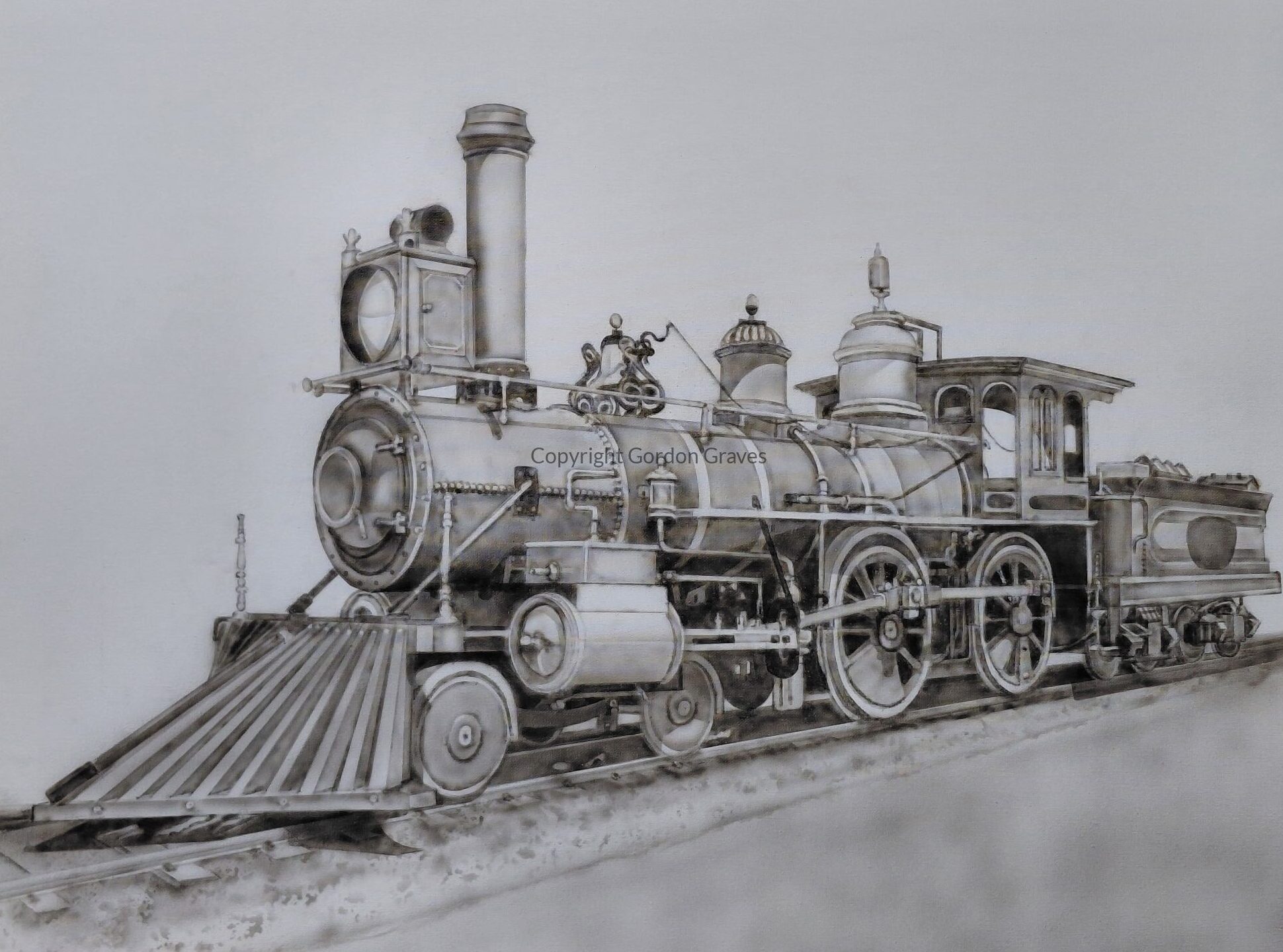
4-4-0 Mid 1800s – Early 1900s
Manufactured by Rogers Locomotive and Machine Works
24″ X 30″ Illustration on Canvas
$450.00
Among the prominent builders of these historic steam engines was Rogers Locomotive and Machine Works of Paterson, New Jersey. During the mid-1800s, Rogers became one of America’s leading locomotive manufacturers, producing powerful and durable steam locomotives for railroads throughout the country.
One of the company’s most famous locomotives was The General, a Rogers-built 4-4-0 completed in 1855 and later made famous during the Civil War’s Great Locomotive Chase of 1862.
The 4-4-0 is also closely associated with the era of westward expansion and the Transcontinental Railroad, when steam power transformed travel, commerce and communication across the American frontier.
The Rogers 4-4-0
The 4-4-0 wheel arrangement means four leading wheels, four large driving wheels, and no trailing wheels. It became so closely associated with American railroads that by the 1870s it was commonly called the “American” type. Roughly 25,000 4-4-0s were eventually produced by builders including Rogers, Baldwin, Cooke and Mason.
Rogers was building 4-4-0s during exactly this period, and we have a spectacular surviving example: The General, Rogers serial No. 631, built in December 1855 for the Western & Atlantic Railroad.
As originally built, The General was a wood-burning 4-4-0, weighing about 50,300 pounds, with 60-inch driving wheels, two 15 × 22-inch cylinders, approximately 140 psi boiler pressure, a wagon-top boiler and the distinctive large balloon smokestack associated with wood-burning American locomotives of the era.
Did you know?
Rogers built The General, the locomotive involved in the famous Great Locomotive Chase of April 1862 during the Civil War.
Rogers locomotives had a reputation for durability and power. One Rogers 4-4-0 built for the Illinois Central in 1853 is reported to have accumulated more than one million miles during roughly 30 years of service.
Rogers ultimately built more than 6,000 locomotives, supplying railroads not only across the United States but internationally. The company’s Paterson factory expanded substantially between 1854 and 1866 specifically to meet growing demand for locomotives and heavy machinery.